The previous article was an introduction to the major worms affecting goats and sheep. This article develops our understanding of the biology of the worm, how sheep and goats become infected and using that knowledge to develop management practices to help control the worm.
While this article is targeted to the Barberpole worm (Haemonchus contortus), the most economically important worm of sheep and goats, most principles apply to the other major roundworm of goats and sheep, the Bankrupt worm or Black scour worm (Trichostrongylus colubriformis). We need to remember that the parasite game is a game of numbers; how many worms does your goat have. A few worms are acceptable, maybe even good, because they keep the immune system active against roundworms, but too many worms will cause lost production, sickness and even death. So, we want to reduce numbers at whatever stages of the life cycle we can, realizing that something out of control at another stage may overwhelm the good that we have done at another stage. We have to look at our whole parasite program. The next article will be devoted to developing a parasite control program to include FAMACHA, a system of scoring the color of the eye mucous membranes (inner surface of lower eyelid). After that, there will be an article on dewormer resistance and selection of dewormers. The last article will cover alternative dewormers.
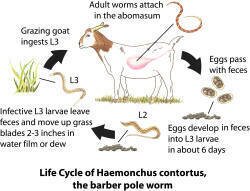
Goats and sheep get infected with worms by picking up infective larva on pasture that have developed from eggs in the fecal pellets. Eggs are laid by worms in the true stomach or upper small intestine and flow with the digesta until it becomes a pellet; undigested residues with the eggs trapped in the residues. Basically, kids and lambs are not infected with roundworms when they are born as may happen with dogs and other species, rather, kids and lambs pick up their first worms from larvae on the pasture. Since they graze little in early life, it may take several weeks for them to pick up their first worms. The first stage in the life cycle of the Barberpole worm is the hatching of the egg in the fecal pellets. The number of eggs available to hatch per acre is important in that if there are few eggs, even with a 100% hatch rate, there will be few infective larvae. Conversely, with many eggs per acre, even with a poor hatch and development success rate, there will be many infective larvae and parasites will be more of a problem.
The number of eggs per acre is affected by two factors, stocking rate and how many eggs the worms in each goat is producing (how many worms the goat has). High stocking rates such as 10-12 animals per acre will produce many more eggs per acre than two animals per acre. It is thought that if you have a stocking rate less than two animals per acre, stocking rate is not a major contributor to pasture contamination. The other factor is the number of worms (and eggs produced by them) produced per animal. For example, if we have slightly wormy animals with 400 eggs per gram in their feces, pasture contamination will slowly build. However, if our parasite problem is bad and a few animals die due to worms, the average fecal egg count of the herd may be 4-10,000 eggs per gram, which very rapidly leads to a high level of pasture contamination. Even when we do deworm, the animal, there are so many infective larvae on pasture that animals will need to be dewormed again in 3 - 4 weeks because they are picking up so many larvae from the pasture. We need to think about pasture contamination as part of our parasite management.
Older parasite management strategies realized the importance of pasture contamination and prevented it by frequent deworming during critical times (usually lactation and summer grazing) which helped to reduce pasture contamination, but such a strategy is now recognized to increase dewormer resistance of the worms due to the frequent deworming. This management strategy is not an acceptable practice because of the increase in dewormer resistance (means that the dewormer that we are using will not kill worms after a short period of time). Also, we can reduce pasture contamination by selecting animals with low fecal egg counts and monitor the level of worm infection of animals with FAMACHA or fecal egg count and deworming animals when needed to avoid heavy pasture contamination. It has been shown that 15% of the wormiest animals contribute 50% of the total eggs on a pasture and 30% of the wormiest animals contribute 75% of the eggs. Culling of these animals will result in a marked reduction in pasture contamination and consequent parasite problems for the whole herd.
Table
Effect of pasture contamination (eggs per acre) and hatch rate on infective larvae
400 eggs 95% hatch = 380 larvae
6,000 eggs 25% hatch 1,500 larvae
Managing pasture for goats and sheep is different from cattle in that instead of maximizing forage or animal production being the management objective, the management objective becomes controlling parasites. Pasture rotation can reduce pasture contamination, especially if there is a long enough rest period for infective larva to die. Grazing sheep or goat pastures with cattle or horses will reduce infective larva since the infective larva die after being consumed by cattle or horses. Levels of infective larva can also be reduced by making hay or tillage. Incorporation of one or more of these management practices into your pasture rotation program, it will help you reduce the level of infective larvae on pastures.
Two conditions are required for worm eggs to hatch and develop to larvae, they are warmth, and moisture (rain, dew, humidity). The Barberpole worm likes it warm with 86oF is the ideal temperature for hatching eggs and developing infective larvae which will result in infective larvae being available in as little as 6 days. Eggs will still hatch up to 100oF, but with a reduction in hatching rate. Barberpole worm eggs do not hatch and develop when temperature is less than 50oF however, the Bankrupt worm will hatch at lower temperatures, which is the reason that they are greater problems in cooler times of the year. This is the reason why there are fewer Barberpole worm problems in winter. In the southeastern US, the winters are not cold enough to kill worm larvae, but the cold weather does slows down hatching and rate of development and reduces pasture contamination and consequent worm problems. However, remember that your animals still have worms from the larvae that they picked up prior to cool weather and infective larvae are still out there on the forage for a period of time.
The major environmental effects on worms are caused by temperature and moisture (rain, humidity or irrigation). Moisture is essential for the eggs to develop to infective larva. This is why worms are little problem in drier climates and a big problem in wetter climates.
Moisture is required for the egg to hatch and develop. The fecal pellet has sufficient moisture in it for the eggs to hatch and develop. In fact, we hatch worm eggs in the laboratory by suspending a cheesecloth bag of fecal pellets in a quart jar with a little water in the bottom (humidity 100%) at room temperature (75oF) for a week or so and the larva are fully developed and ready to be used to infect animals. Underneath some sod pastures such as Bermudagrass, the microenvironment is humid and not as hot as the outside temperature, resulting in ideal egg hatching conditions during the summer. In drier areas or when the weather is dry, the pellet crusts over and as the pellet dries from the outside in, the developing larvae move towards the center of the pellet where it is more moist. Dry conditions will reduce the success rate of hatching and especially hot, dry conditions. This is the reason why worms are less of a problem during drought (except when animals graze down close to the ground). If the pellet is in open pasture and exposed to the sun, the pellet will be heated over 100oF and the longer such conditions prevail, more eggs and larvae will die in the pellet.
The egg, under conditions of warmth and humidity hatches in the pellet to a first stage larva abbreviated L1. This larva cannot infect your goat, but must grow and develop through several larval stages to become an infective larva. The first stage larva wiggles his way through the fecal pellet, eating bacteria and growing. Then it molts, this is somewhat like a snake shedding his skin and becomes a second stage larva (L2). The second stage larva does much the same thing as the first stage larva, wiggling his way through the fecal pellet, eating bacteria and growing. The second stage larva then molts to become a third stage larva (L3) which is the infective stage larva that your goat will pick up from pasture. This will happen as quick as 6 days in temperate regions and 4 days in tropical regions. However, this molt is an incomplete molt. The skin only partially comes off and slips down the worm's body. This is a good news/bad news situation. The good news is that the larvae has a second skin which makes him more resistant to drying out (L1 and L2 are susceptible to being killed by drying out). The bad news is that the partially shed skin covers his mouth which prevents him from eating. This means that he must live off his body stores until he gets into your goat. If his body stores run out before he gets into your goat, he dies. These larva are very small, like the thickness of spider web and about as long as the period at the end of this sentence, so you cannot see them with your eye. If you have a good magnifying glass and know what you are looking at, you can see the larvae (look like eyelashes).
Larva may be killed in the feces by nematophagus (worm trapping) fungi, literally fungus which parasitize nematode larvae (worms are also called gastrointestinal nematodes). The fungus forms loops that look like an Easter basket handle and as the larva wiggles his way through the fecal pellet, he goes through the loop which traps him. The fungus then kills the larva and uses its body to reproduce more fungus. These fungi are normally present in feces at a low levels and do reduce larval numbers to a small degree. However, research on feeding high levels of fungal spores to animals greatly reduced the number of infective larva and thus is effective in reducing pasture infectivity. But, the fungal spores must be fed every day to be effective. Hopefully a commercial product will be developed from this technology. In addition, the forage, sericea lespedeza appears to reduce hatch rate and development of larvae in the feces, also aiding in reducing pasture contamination. A similar reduction in hatch rate and larval development has been observed for a number of plants, many of which contain tannin. However, there are many types of tannins and not all are effective against worm eggs and larva.
Since the larva is cold-blooded, his metabolism runs slow in cold weather, his body stores will last a long time, and he may survive as long as 180 days. However, when it is hot (summer), his metabolism goes much faster, burning up the body stores and may survive only 30-40 days. There are several studies on grazing systems to avoid parasites using rotation grazing. A study on native species range in the US (Oklahoma) utilized 14 pastures and moved animals every 5 days with a 65 day rest period during the summer. Animals were fenced in with temporary electric fencing which was moved every 5 days. Fecal egg counts of goats remained low throughout the summer and pasture contamination was low. Animals were moved before any L3 infective larvae had developed and the infective larvae that did develop later, died during the 65 day rest period since the weather was hot. Forage quality remained good since this was a native tallgrass pasture. If improved grasses are used in this grazing system, the forage quality would be too low at the end of 65 days to be nutritious to animals. Therefore, some modifications would be suitable for utilizing such improved grasses. Grazing cattle or horses 3 to 4 weeks after the goats would help in that they would pick up goat and sheep worms which would not infect them as they have different worm parasites. Goats would follow the cattle or horses in 3 to 4 weeks. Another option is to make hay on the pasture which may eliminate most of the larvae. When the larvae are baled up with the hay, they will eventually die when they run out of body stores. And, since hay bales often generate heat, the larva can die from the high temperature. A grazing system in the tropics used a 3.5 day grazing period (moved animals off pasture before there were any L-3 infective larva) and 31.5 days of rest (larva ran out of body stores in hot tropical weather). This was a 10 pasture grazing system on alfalfa. Using these types of grazing systems, it would be possible to raise goats and/or sheep with little use of dewormers.
Tillage is another way to reduce larval contamination on pastures. If larvae are buried under an inch of soil, most will die. If annual pastures such as winter wheat, or ryegrass or summer sudangrass are grazed, tillage between grazing seasons will kill many infective larvae from the previous grazing season, creating a pasture with reduced infectivity.. Several chemicals have been investigated for use in killing larva on pastures and to date, no product has proven effective. Pasture rotation, at appropriate intervals, may reduce the number of infective larvae your goat consumes. However, worms are not effectively reduced by a 4 pasture rotation system when animals graze one week in each pasture. This is because the 3 week rest period is just enough time for infective larvae to build up to maximum levels and not long enough for larvae to die. .Trees can increase parasite problems because they provide shade, humidity and cause animals to congregate (more feces, grass grazed close to ground, more mouths to pick up infective larvae). Rotation grazing with a long rest period reduces problems caused by trees. Barns and watering areas can concentrate animals and also have a similar effect to trees.
Management factors that reduce worm problems
1. Pasture rotation, especially with a long rest period
2. Grazing pastures with cattle or horses
3. Harvesting hay
4. Tilling soil on annual pastures
5. Grazing browse
Once the larva reaches the infective stage, he has a problem: He can't very well get into a goat to infect him it is still in the fecal pellet since goats don't generally go around eating fecal pellets. The fecal pellet has a hard crust on it by a week after the goat produced it and the larva can't penetrate this crust to escape. The pellet needs to be broken up so the larva can escape. Generally, rain soaks the pellet, softening the crust making it easier to be broken up. Two inches of rain in a month's time is sufficient to enable larvae to escape. The goat's feet may also break open the pellet as well as fowl or wildlife. If the pellets are broken up shortly after the goat dropped it, the pellet will dry out and the L1 and L2 larvae and eggs in the pellet will quickly die. However, if the pellet is broken open when there are infective L3 larvae present, they will be released to infect the goat. After being released from the pellet, the infective larvae travel on a film of water (from dew or rain). The larvae cannot swim, but wiggles and drifts wherever the film of water takes them. Larvae may be carried up a pasture plant or under plant residues such as a fallen leaf. They only go as far as the film of water takes them, usually only two to three inches up the plant. The infective larva rests on the plant where the moisture has taken it so it can then be consumed with the plant by grazing animals. The infective larvae can live on the plant until they run out of body stores. If the larvae in the pellet is not released, they can survive in the pellet until they run out of body stores. So, that can be a month or more before rain comes along to release them. A heavy rain can cause the release of a month's accumulation of infective larvae, resulting in a sudden, dramatic increase in infective larva on the pasture. Very hot temperatures especially when it is dry can result in a high mortality rate for the infective larvae, reducing pasture infectivity. Generally, larvae accumulate over the summer grazing season, making for greater parasite problems in mid- and late- summer if there is adequate moisture. This is one reason why kids born early in the kidding season often do better and wean heavier than kids born late in the kidding season.
Since the larva do not go very high up the plant, when goats consume browse, they pick up very few larvae since they are eating higher than the larvae and therefore, usually have very few worm problems. Conversely, when pastures are grazed short, goats and sheep consume many larvae, resulting in major worm problems. On some pastures such as bermudagrass, goats will patch graze i.e. have favorite spots where the pasture is grazed down to less than 3 inches high. This will result in a heavy worm infection even though most of the pasture is greater than 3 inches high. The solution to patch grazing is rotation grazing.
Once the infective larva has been consumed by a sheep or goat, it molts to a fourth stage larva. This larva may suck blood and further develop into an adult worm complete with sex organs and mate, producing eggs in about three weeks, or it may become arrested in development (arrested fourth stage larva), kind of like hibernating in the stomach. One caution with fecal egg counts, if the animal suddenly picks up a large number of infective larva, they are sucking blood but there will not be any eggs showing up in the feces until 3 or 4 weeks later. So negative or low fecal egg counts do not always mean no or few worms. Since it takes at least a week for the egg to hatch and develop to infective larvae and then at least three weeks to develop to maturity and lay eggs after ingestion by the goat or sheep the generation interval is 4-5 weeks for the Barberpole worm. This is the reason why deworming every 4-6 weeks is so effective at developing dewormer resistance, because each generation of worms is selected for dewormer resistance. Also, the 4-5 week generation interval is why the Barberpole worm can build its population numbers so explosively under good environmental conditions (warm temperatures and frequent rain or irrigation).
The arrested form of the larvae is a survival mechanism, enabling the Barberpole worm to survive the winter in cold environments. The eggs produced by worms during the winter do not hatch due to cold temperatures. Many of the worms in the animal that are laying eggs will die of old age over the winter. The average life span of an adult worm is 4-6 months, but some may live longer. A strong immune response by the animal can cause early death of the worms. Worm and fecal egg counts will often be low in the springtime. The arrested larvae are in reserve, safely nestled down in the glands in the stomach where they do not trigger an immune response. The arrested larva requires a higher dose of the benzamidole class of dewormers (Panacur, Safeguard, Synanthic, Valbazen) to kill them. Since these dewormers were less effective on arrested worms, it was a common recommendation in years past to deworm again two weeks after the first deworming when the arrested larvae developed and took the place of the worms that were killed. Sequential dewormings are not needed with other classes of dewormers such as ivermectin (Ivomec), moxydectin (Cydectin) or levamisole (Tramisol, Levasole or Prohibit) are used because they are effective at killing arrested larva of the Barberpole worm.
The main trigger for the arrested form to develop into an adult is kidding or lambing. The exact mechanism for triggering the development of the arrested worms is not known, although, longer day length, kidding, lactation and green grass are all supported by scientific evidence. This is the reason for the recommendation to deworm around kidding/lambing time. By deworming at this time, you may eliminate most of the arrested larva as well as active worms (depending on the dewormer resistance status of the worms; worms and larvae that are resistant to the dewormer used will survive) and start the kidding season with very low level of pasture contamination. In addition, the lactating animal is very susceptible to worm infection (from grazing) during this time because lactation depresses the doe's or ewe's immune system.
The immune system is the first line of defense against worms. The immune system has genetic and environmental components that determine its effectiveness at suppressing worms. Since fecal egg counts are moderately heritable, one can make progress over several generations by selecting animals for low fecal egg counts. Genetics of the herd can also be improved by simply culling the worst animals each year as identified by FAMACHA eye scores. Since the buck contributes more than 50% of the genetic material to the herd, his genotype is very important. Not only should his fecal egg counts or FAMACHA scores be evaluated, but the fecal egg count or FAMACHA scores of his sons and daughters. Culling animals with high fecal egg counts or high FAMACHA scores can not only improve the herd genetics for resistance to worms, but also substantially reduce the number of infective larvae on the pasture, thus reducing worm problems for the whole herd.
The major environmental components of the immune system are nutrition and stress. It is well known that stress depresses the immune system. This includes stress such as other sickness (coccidiosis, pneumonia, pinkeye etc.), shipping, putting with a new group of animals (need to establish pecking order) etc. Nutrition includes adequate protein and energy as well as minerals and vitamins. When animals suffer from poor nutrition, nutrients going to the immune system are diverted to other body functions so the animal may survive, but this makes the animal more susceptible to disease and parasites. There are many examples in the literature of protein and/or mineral supplementation decreasing fecal egg counts, likely by boosting the immune response.
The animal's immune system is the first line of defense against worms. Some animals are more resistant than others to worms due to genetics. However, the immune system must be fueled by good nutrition. The immune system can be depressed by disease or stress, making the animal more vulnerable to worms.



